Solar Generator vs Gas Generator for Rural Land: The 10-Year Cost Breakdown
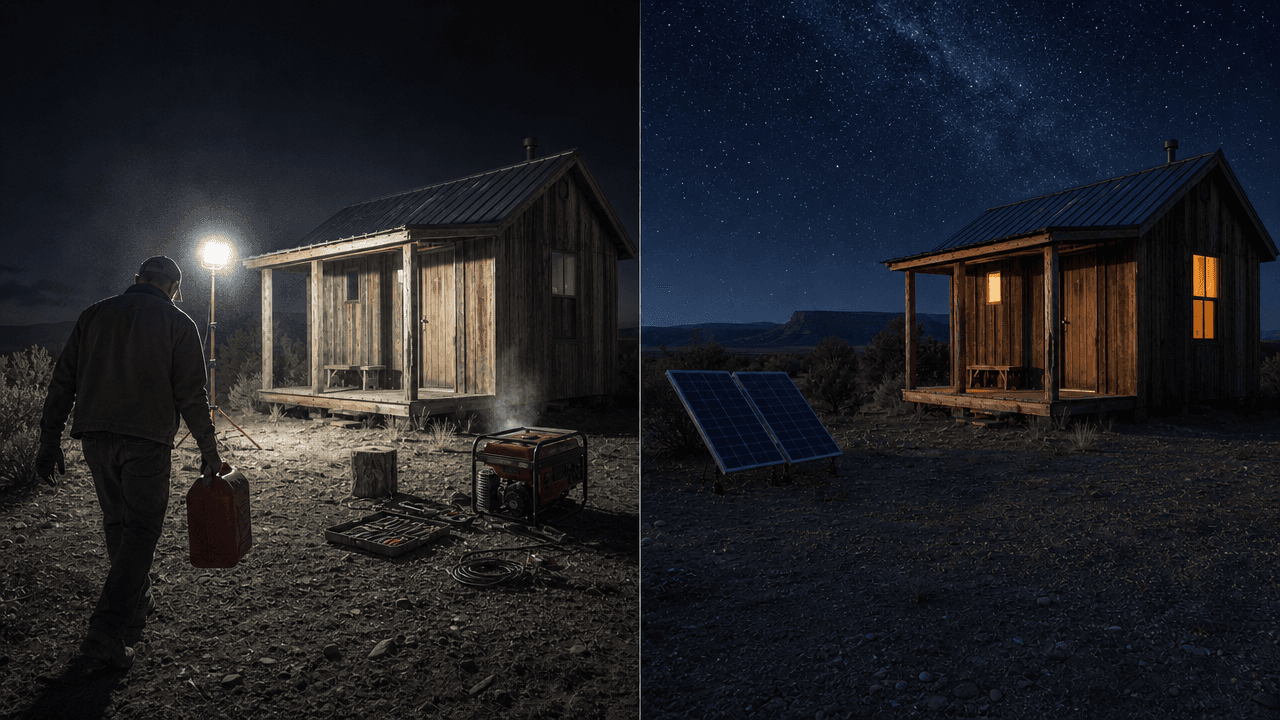
Same cabin, same night: running on gas versus running on solar.
Most people buying rural land hit the same question within the first month: do you run a gas generator, or invest in solar? Get it wrong and you either burn thousands of dollars a year in fuel or buy a solar system that dies on day three of a cloudy week. This solar generator vs gas generator comparison runs the real 10-year numbers for two common setups, a weekend cabin and a full-time homestead, so you can pick based on math instead of marketing.
Quick Summary
For a weekend cabin, a solar generator costs about $3,000 once, while a gas generator costs about $6,600 over 10 years once fuel and maintenance are added. For full-time off-grid living, solar costs about $19,500 over 10 years versus $58,700 for gas. Gas still wins for heavy surge loads and long cloudy stretches, so most landowners end up with solar plus a small gas backup.
This article contains affiliate links. If you purchase through our links, we may earn a commission at no extra cost to you. We only recommend products we believe in.
Solar Generator vs Gas Generator: The Short Answer
If you will use power most days, solar is cheaper within three to five years and far easier to live with. If you only need power a few weekends a year, or you need to run a welder or a big 240V pump, a gas generator still makes sense.
The decision gets easier once you separate two costs: what you pay up front, and what you pay every time you flip a switch. Gas is cheap to buy and expensive to run. Solar is the reverse.
What a "Solar Generator" Actually Is
"Solar generator" is a marketing term. It is a portable power station, meaning a lithium battery, an inverter, and a charge controller in one case, paired with solar panels. Nothing inside it generates anything; the panels harvest energy and the battery stores it.
A gas generator is a small engine spinning an alternator. It makes power on demand for as long as you keep feeding it fuel. That difference drives every trade-off below.
The 10-Year Cost Breakdown
We modeled two common situations on rural land. Assumptions: gas at $4.00 a gallon (the AAA national average was $4.48 in late September 2026, so these gas numbers are conservative), about 3 kWh of usable power per gallon at typical off-grid loads, and routine oil and spark-plug maintenance.

10-year cost for a full-time homestead using 8 kWh a day.
The full-time column is the one that surprises people. Running a portable gas generator eight hours a day wears out the engine in about 16 months, so you are not buying one generator; you are buying seven. That is the same math behind our solar vs utility line extension cost breakdown: recurring costs dwarf the sticker price.
Noise, Safety, and Maintenance Off the Grid
Carbon monoxide: the biggest safety gap between solar and gas generators
The CPSC estimates that about 100 people die each year from carbon monoxide linked to portable generators. Its guidance is to keep the exhaust at least 20 feet from any building, never in a garage or under a carport. A solar generator produces no exhaust, so it can sit inside your cabin next to the refrigerator.
Noise and neighbors
A good inverter generator runs around 50 to 60 decibels, roughly a normal conversation. Open-frame construction-style generators are much louder. Solar generators make little more than a cooling-fan hum, which matters when the whole point of rural land is quiet.
Maintenance and fuel storage
Gas generators need oil changes, spark plugs, carburetor cleaning, and fresh fuel. Untreated gasoline can go stale in a few months, which is a real problem on land you visit occasionally. Lithium iron phosphate (LiFePO4) batteries are rated for thousands of charge cycles and need almost nothing besides keeping the panels clean. Our guide to the best batteries for off-grid solar covers how long they really last.
Where a Gas Generator Still Wins
- Big surge loads: welders, air compressors, and deep 240V well pumps can need 5,000+ watts at startup.
- Long cloudy stretches: a week of overcast winter weather can drain any battery bank.
- Lowest upfront cost: if you only need power a few days a year, $1,200 beats $3,000.
- Instant capacity: add fuel and you have more power; adding solar capacity means buying more panels and batteries.
If your land needs a well, check your pump's specs first. Our article on whether solar can power a well pump walks through the surge math.
The Hybrid Setup Most Landowners End Up With
In practice, the best answer to solar generator vs gas generator is often both. Size solar for your everyday load, then keep a small inverter generator for cloudy streaks and the occasional power tool. The generator might run 50 hours a year instead of 2,900, so fuel and wear costs nearly disappear.

A hybrid setup: solar for daily power, a gas generator kept well away from the cabin for backup.
Many larger power stations can charge from a generator and from solar panels at the same time, which makes this setup simple. For step-by-step installation, see our off-grid solar setup guide for cabins.
Prices last checked September 2026 and may change.
| Product | Best For | Key Spec | Price | |
|---|---|---|---|---|
| Renogy Off-road Adventurer Kit (400W | 2.56kWh) | Weekend cabins, 1-2 kWh/day | 400W solar + 2.56 kWh LiFePO4 battery | $2,399.99 | Check Price → |
| EcoFlow DELTA Pro 3 Power Station | Part-time to full-time living, hybrid with a generator | 4,096 Wh LiFePO4, expandable | $2,799 $3,299 SALE | Check Price → |
| Renogy Core Mini LiFePO4 12.8V 100Ah (2 Pack) | Expanding a 12V kit's storage | 2 x 100Ah LiFePO4 | $595.98 | Check Price → |
Best for a solar-plus-backup hybrid setup
EcoFlow DELTA Pro 3 Power Station
- ✓ 4,096 Wh LiFePO4 battery, expandable
- ✓ Charges from solar panels and a generator
- ✓ Silent and safe to run indoors
- ✓ Large enough for a refrigerator, lights, and tools
*Affiliate link — we may earn a commission at no extra cost to you.
How to Decide for Your Land
Solar or gas? Answer these five questions
- ✓How many days a year will you use power on the land? (Under 30: gas is fine. Over 100: solar wins.)
- ✓What is your daily load in kWh? Add up the watt-hours on your appliance labels.
- ✓Do you need 240V or a big surge (well pump, welder, compressor)?
- ✓How many full-sun hours does your parcel get in winter?
- ✓Will you leave equipment on the land unattended? (Stale fuel and theft both matter.)
Most of La Vie's parcels in Arizona, New Mexico, Nevada, and West Texas get strong sun nearly year-round, which tilts the math toward solar. The complete guide to solar power for off-grid living covers system sizing in more depth.
The Bottom Line
In the solar generator vs gas generator decision, gas is the cheap way to start and the expensive way to live. If you will spend real time on your land, put the money into solar, keep a small gas generator for the rare bad week, and you will spend less, sleep better, and never haul another fuel can up a dirt road.
Ready to find land with room for panels? See how La Vie's owner financing works, then browse available properties.
Free Checklist Download
Get the printable checklist for this guide
Ready to Find Your Perfect Land?
Browse our available properties or schedule a free consultation with our team.